
30ft vs. 60ft vs. 100ft Inflatable Obstacle Course: How Much Space and How Many Kids?
You're planning a backyard party and an inflatable obstacle course sounds perfect—until you realize there are wildly different sizes to choose from. A 30ft course, a 60ft course, and a 100ft course all look similar in photos, but the real-world difference in space, capacity, and experience is massive.
Choosing the wrong size means either cramming a 100-footer into a yard that can't hold it, or renting a 30-footer that leaves 40 kids standing in line for 90% of the party. This guide breaks down exactly how much yard space each size requires, how many kids they handle comfortably, and which one matches your party's age group and vibe.
By the end, you'll know which obstacle course fits your backyard, your guest list, and your party goals—without measuring tape confusion or last-minute surprises.
Table of Contents
- Which Obstacle Course Size Fits Your Party Type?
- How Much Backyard Space Does Each Size Actually Need?
- How Many Kids Can Use Each Obstacle Course at Once?
- How Long Does It Take Kids to Complete Each Course?
- What Age Groups Work Best for 30ft, 60ft, and 100ft Courses?
- What Elements and Obstacles Come with Each Size?
- Does Your Yard Shape and Slope Matter?
- Frequently Asked Questions
Which Obstacle Course Size Fits Your Party Type?
Not all parties need the same inflatable experience. A backyard birthday with 10 preschoolers has completely different needs than a school field day with 60 mixed-age kids. The key isn't just matching the size to your space—it's matching it to your guest list, age range, and party duration.
30ft Obstacle Course
Best for: 8-15 kids, ages 4-8, intimate backyard birthday parties
Compact, fast-paced, and perfect when the obstacle course is one of several activities. Kids complete runs in under a minute, so lines move quickly even with a smaller guest count. Ideal when you also have a bounce house, games, or pool time planned.
Space needed: 35ft × 12ft
60ft Obstacle Course
Best for: 15-25 kids, ages 6-12, standard birthday parties or family reunions
The sweet spot for most backyard parties. Long enough to feel like a real challenge, short enough to keep kids engaged without fatigue. Run times average 90 seconds to 2 minutes, giving kids a satisfying experience without excessive wait times.
Space needed: 65-70ft × 12ft
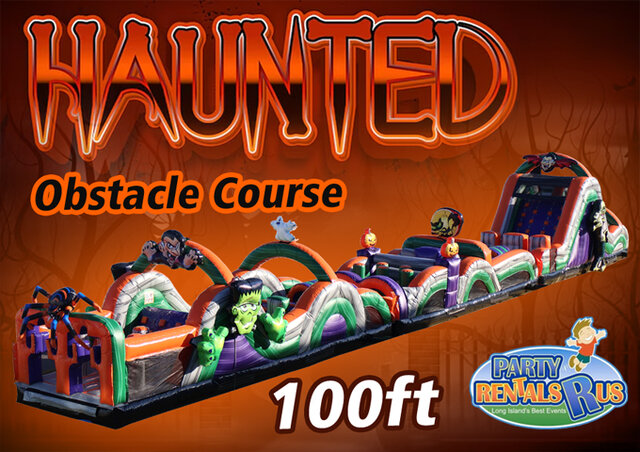
100ft Obstacle Course
Best for: 25-40+ kids, ages 8 and up, school events, church gatherings, or teen parties
Built for high capacity and extended play. Multiple kids can race simultaneously, and the length creates a true obstacle challenge. Expect 2-3 minute run times. This is the size you choose when the inflatable is the main event, not just one activity.
Space needed: 105-110ft × 12ft
💡 Pro Tip: If your guest count falls between two sizes, round up. A 60ft course with 12 kids will feel spacious and fun. A 30ft course with 18 kids will feel like a bottleneck. Undersizing creates wait time frustration; oversizing just means more room to play.
How Much Backyard Space Does Each Size Actually Need?
The advertised length of an obstacle course—30ft, 60ft, 100ft—is just the inflatable's footprint. You need additional clearance on all sides for safe setup, anchoring, and blower placement. Most first-time renters underestimate this and discover setup day that their "plenty of space" yard is actually too tight.
Here's the real space breakdown for each size, including the buffer zones professional rental companies require.
30ft Obstacle Course Space
Minimum yard size: 35 feet long × 12 feet wide
- Inflatable footprint: 30ft × 10ft
- Entry/exit buffer: 3 feet on each end
- Side clearance: 1 foot on each side for stakes and ropes
- Blower placement: 6 feet from one side or end
This is the only size that fits comfortably in most suburban side yards or smaller rectangular backyards. If you have a pool, deck, or large playset, this may be the only option that leaves enough open lawn.
60ft Obstacle Course Space
Minimum yard size: 70 feet long × 12 feet wide
- Inflatable footprint: 60ft × 10-11ft
- Entry/exit buffer: 4-5 feet on each end
- Side clearance: 1 foot on each side
- Blower placement: 6-8 feet from one side
Most standard suburban backyards can accommodate this if the lawn area is relatively open. You'll need to move patio furniture, but it won't dominate the entire yard. Measure diagonally if your yard is L-shaped or irregular.
100ft Obstacle Course Space
Minimum yard size: 110 feet long × 14 feet wide
- Inflatable footprint: 100ft × 12ft
- Entry/exit buffer: 5 feet on each end
- Side clearance: 1-2 feet on each side
- Blower placement: 8 feet from one side
This size requires a large open lawn or field. It's not realistic for most residential backyards unless you have acreage or a very long rectangular lot. Many customers rent this for parks, school fields, or church grounds where space isn't an issue.
⚠️ Measurement Tip: Walk your yard with a tape measure before booking. Obstacles like trees, fences, AC units, and sprinkler heads all reduce usable space. If your measurement is within 5 feet of the minimum, you're cutting it too close—round down to the next size.
How Many Kids Can Use Each Obstacle Course at Once?
Capacity isn't just about weight limits—it's about active throughput. How many kids can physically be on the obstacle course at the same time, moving through it safely without collisions or bottlenecks? This determines how fast your party flows and whether kids spend more time playing or waiting.
Here's what each size handles in real-world party conditions.
30ft Capacity
Active users: 1-2 kids at once
Total on structure: 3-4 kids (including those at entry/exit)
Weight limit: 400-500 lbs
Realistic party throughput: 12-15 kids per hour
Best for small groups where the obstacle course is one of several activities. Kids rotate between this, a bounce house, lawn games, or swimming. If you have 15 kids and this is the only inflatable, expect some downtime in line.
60ft Capacity
Active users: 2-3 kids at once
Total on structure: 5-6 kids (including staging areas)
Weight limit: 600-700 lbs
Realistic party throughput: 20-25 kids per hour
The sweet spot for standard birthday parties. You can stagger starts every 20-30 seconds, so the line keeps moving. Kids get multiple turns during a 2-hour party window without long waits. For a detailed comparison of other inflatable options, check out our bounce house rental guide.
100ft Capacity
Active users: 3-4 kids at once (often dual lanes)
Total on structure: 8-10 kids (with multiple checkpoint zones)
Weight limit: 800-1000 lbs
Realistic party throughput: 30-40 kids per hour
Built for high-volume events. Multiple kids race side-by-side or with staggered starts every 15-20 seconds. Perfect for school field days, church festivals, or corporate family events where 40+ kids need continuous entertainment.
💡 Capacity Rule of Thumb: Divide your total guest count by 3, then multiply by the average run time (in minutes). If that number is higher than 10 minutes, you need a larger obstacle course or a second inflatable. Kids lose interest if they wait more than 10 minutes between turns.
How Long Does It Take Kids to Complete Each Course?
Run time is one of the most overlooked factors when choosing an obstacle course size. A course that's too short feels anticlimactic—kids finish in 30 seconds and immediately want another turn. A course that's too long exhausts younger kids halfway through, and they lose interest or slow to a crawl.
Here's what to expect based on age and course length.
30ft Run Time
Ages 4-6: 60-90 seconds
Ages 7-10: 45-60 seconds
Ages 11+: 30-45 seconds
The compact length means fast, energetic runs. Younger kids love the quick turnaround—they can go again and again without getting winded. Older kids and teens may find it too short unless they're racing head-to-head for competition.
60ft Run Time
Ages 4-6: 2-3 minutes
Ages 7-10: 90 seconds to 2 minutes
Ages 11+: 60-90 seconds
The ideal middle ground. Kids get a satisfying challenge without fatigue. The length creates just enough physical exertion that they feel accomplished at the end, but they're ready to go again after a short break. This timing works perfectly for birthday party flow.
100ft Run Time
Ages 4-6: 4-5 minutes (often too long)
Ages 7-10: 2.5-3 minutes
Ages 11+: 2-2.5 minutes
This is a true endurance challenge. Younger kids often lose steam halfway through and need encouragement to finish. Older kids and teens love the competitive length—especially when racing head-to-head. Best reserved for ages 8+ unless your younger guests are unusually active.
⚠️ Age Mismatch Warning: If your party has a wide age range (say, 5-year-olds and 12-year-olds), the older kids will zoom through a 30ft course in 30 seconds while younger kids struggle with a 100ft course. In mixed-age scenarios, a 60ft course is your safest compromise.
What Age Groups Work Best for 30ft, 60ft, and 100ft Courses?
Age isn't just about safety—it's about engagement. A 5-year-old on a 100ft course will get halfway through, sit down, and wait for help. A 13-year-old on a 30ft course will sprint through it once, shrug, and go find their phone. Matching the course length to your guests' developmental stage makes the difference between kids who play for two hours straight and kids who lose interest in 10 minutes.
Here's the breakdown by age group and what they actually enjoy.
Ages 4-6: Preschool and Early Elementary
Best size: 30ft obstacle course
Kids this age have short attention spans and limited stamina. They want quick wins—activities they can complete in under 2 minutes that give them an immediate sense of accomplishment. A 30ft course is just long enough to feel like an adventure but short enough that they don't tire out or lose focus.
They also repeat activities obsessively. A preschooler will happily run the same 30ft course 15 times in a row. The compact size supports that behavior—they can cycle through quickly, getting the repetition they crave without long waits. For more ideas on age-appropriate party entertainment, explore our inflatable party entertainment guide.
Why longer courses don't work: A 60ft or 100ft course feels overwhelming. They hit a tunnel or tall climb midway through, slow down, and need verbal encouragement from parents to keep going. By the end, they're tired and less likely to want a second turn.
Ages 7-10: Elementary School Sweet Spot
Best size: 60ft obstacle course
This is the Goldilocks age range for inflatable obstacle courses. Kids have the stamina for a real challenge but still love the playful, bouncy nature of inflatables. They want something that feels like an accomplishment—not a sprint they finish in 30 seconds.
A 60ft course hits the sweet spot: long enough to feel like a race, short enough to avoid fatigue. Kids this age also start caring about competition—they'll race each other, time themselves, and create their own challenges ("Can you do it without using your hands?"). The 60ft length gives them room to strategize without overwhelming them.
Why 30ft feels too short: Seven- to ten-year-olds will blast through a 30ft course in under a minute and immediately ask, "That's it?" They want more complexity.
Why 100ft can be too much: Unless your party is 3+ hours or you have 30+ kids, a 100ft course means long waits between turns. Kids this age get bored standing in line, and you'll spend more time managing the queue than they spend playing.
Ages 11-14: Tweens and Middle School
Best size: 100ft obstacle course (or competitive 60ft racing)
Tweens and teens want a real physical challenge—something that pushes them, makes them sweat, and feels like an athletic accomplishment rather than a "little kid" activity. A 100ft obstacle course delivers that intensity. The length, combined with tougher obstacles like vertical climbs and squeeze-through tunnels, creates a legitimate workout.
If you're renting a 60ft course for this age group, make sure it supports head-to-head racing. Tweens care about competition, not just completion. They want to beat their friends' times or race side-by-side.
Why 30ft doesn't work: They'll go once, declare it "for babies," and spend the rest of the party on their phones. You need something that feels age-appropriate.
Mixed-Age Parties (Ages 5-12)
Best size: 60ft obstacle course
If your party includes siblings, cousins, or neighborhood kids spanning a wide age range, a 60ft course is the safest compromise. Younger kids can complete it with effort but without exhaustion. Older kids find it challenging enough to stay engaged, especially if they race or time themselves.
Avoid the temptation to go bigger "just to be safe." A 100ft course will frustrate your youngest guests, and you'll spend the party retrieving tired 5-year-olds stuck halfway through.
What Elements and Obstacles Come with Each Size?
Size isn't just about length—it's about obstacle variety. A longer course doesn't just repeat the same tunnels and climbs; it introduces new challenges that test different skills. Understanding what obstacles come with each size helps you choose the experience you want, not just the footprint that fits your yard.
Here's what kids actually encounter on each course length.
30ft Course: Foundational Obstacles
- Pop-up barriers — soft inflated columns kids weave around or push through
- Low crawl tunnel — usually one short tunnel section, 4-6 feet long
- Small climb wall — 3-4 feet tall with easy grip surfaces
- Single slide exit — short, gentle slope to end the course
The focus is on movement and speed rather than complex problem-solving. Obstacles are straightforward—kids know immediately what to do without needing instruction. Perfect for younger kids who want action without intimidation.
60ft Course: Multi-Stage Challenge
- Multiple tunnel sections — alternating crawl-through and squeeze-through zones
- Tire or pillar obstacles — kids navigate around or through vertical barriers
- Medium climb wall — 5-7 feet with grip handles
- Balance beam or log roll — wobbly inflated sections that test coordination
- Slide or drop exit — moderate incline, sometimes dual lanes for racing
This length introduces obstacle variety—kids aren't just running, they're climbing, balancing, and navigating. The multi-stage design creates natural pacing: sprint through the tunnel, slow for the climb, sprint again. To learn more about choosing the right inflatable size for your needs, see our bounce house size guide.
100ft Course: Full Endurance Experience
- Extended tunnel systems — multiple crawl, squeeze, and blackout tunnel sections
- Tall vertical climbs — 8-10 feet with rope or handle assists
- Obstacle gauntlets — tires, pillars, pop-ups in rapid succession
- Balance and agility zones — inflated beams, wobbly surfaces, squeeze-throughs
- Dual-lane racing sections — side-by-side competition zones
- Large slide exit — steep drop, sometimes 10-12 feet tall
This is a true athletic course. The length allows for dramatic obstacle sequencing—just when kids think they're done with tunnels, they hit a tall climb. Just when they recover from the climb, they face a balance beam. The variety keeps older kids engaged and prevents the course from feeling repetitive.
💡 Themed Courses Add Excitement: Many 60ft and 100ft obstacle courses come in themed designs—space adventure, jungle trek, superhero challenge. Themes don't change the obstacles, but they dramatically increase excitement for kids who love immersive play. Ask your rental company about themed options when booking.
Does Your Yard Shape and Slope Matter?
You can have a yard that's technically long enough for a 100ft obstacle course but still can't fit one. That's because usable space depends on more than linear measurements—yard shape, slope, and obstacles all affect whether a rental company can safely set up an inflatable.
Here's what rental professionals look for when evaluating your yard—and what might disqualify a setup.
Yard Shape: Straight Run vs. Curved or L-Shaped
Obstacle courses need a straight, unobstructed run. If your yard is 80 feet long but curves around trees or has an L-shape where one section is 40 feet and another is 40 feet, that doesn't work. Inflatables can't bend or turn corners—they're a single rigid structure when inflated.
If your yard isn't a straight rectangle, measure the longest single stretch of open lawn. That's your usable length. If trees, fences, or structures break up the space, you may need to downsize.
Slope and Grade: How Flat Does It Need to Be?
Inflatable obstacle courses require a mostly flat surface. A slight grade—1 to 2 inches of elevation change over 30 feet—is usually acceptable. Anything steeper creates safety issues and prevents proper anchoring.
Why slope matters:
- Uneven inflation: One end sits lower, causing the inflatable to lean or sag
- Anchor failure: Stakes on the low side bear more tension and may pull out
- Kid safety: Kids slide or tumble toward the low end instead of moving through obstacles intentionally
If your yard has a noticeable slope, a rental company may decline setup or suggest positioning the course diagonally to minimize grade. For safety considerations when setting up inflatables, review our bounce house safety rules.
Ground Obstructions: What's in the Way?
Even if your yard measures correctly, obstacles within the setup zone can disqualify it:
🚩 Ground-Level Issues
- Sprinkler heads — can puncture the inflatable bottom
- Tree roots — create uneven surfaces and prevent stakes
- Rocks or debris — must be cleared completely
- Low stumps — anything protruding from the ground
🚩 Overhead Clearance
- Low-hanging branches — need 3 feet clearance above the inflatable peak
- Power lines — absolute disqualifier for safety
- Clotheslines or cables — must be removed or raised
Professional rental companies won't set up near power lines under any circumstances—it's a strict liability issue. If your yard has overhead lines crossing the setup area, you'll need to choose a different location or downsize to a smaller inflatable that fits elsewhere.
Access Path: Can They Get It There?
A 100ft obstacle course doesn't magically appear in your backyard—it has to be physically carried or rolled through your property. If your backyard is fenced with a 36-inch gate, and the inflatable (when deflated and rolled) is 48 inches wide, it won't fit.
Minimum gate/access width by size:
- 30ft course: 36-inch gate clearance
- 60ft course: 42-48 inch gate clearance
- 100ft course: 48-60 inch gate clearance (often requires double gates open)
If your side gate is too narrow, rental companies may ask to go through your house or garage—assuming those paths are wide enough and your floors can handle the weight of a rolled inflatable on a dolly.
⚠️ Always Disclose Yard Conditions: When booking, tell the rental company about slopes, narrow gates, overhead lines, or unusual yard features. Surprises on setup day lead to cancellations or unsafe installations. Honest communication ensures your party goes smoothly.
Frequently Asked Questions
How long does a 30ft inflatable obstacle course take to complete?+
Most kids complete a 30ft obstacle course in 45 seconds to 1 minute per run. Younger children (ages 4-6) may take closer to 90 seconds as they navigate the elements more carefully. The compact design means fast turnaround times, making it ideal for birthday parties where you want to keep lines moving.
What's the actual difference in space needed between a 60ft and 100ft obstacle course?+
A 60ft obstacle course typically requires 65-70 feet of yard length when you account for entry/exit zones. A 100ft course needs 105-110 feet. The width remains similar (10-12 feet), but the length difference is substantial—about the size of an additional sedan parked end-to-end. Always measure your backyard's usable length before booking. For more guidance on party planning logistics, explore our backyard birthday party planning guide.
How many kids can use a 100ft obstacle course at once?+
A 100ft obstacle course accommodates 2-4 kids actively running at once, depending on lane configuration. With staggered start times (15-20 seconds apart), you can cycle through 20-30 kids per hour. Most units have a 600-800 lb total weight capacity, which translates to about 6-8 kids on the structure at any given moment when accounting for those waiting at checkpoints.
Can a 30ft obstacle course fit in a small backyard?+
Yes, if you have at least 35 feet of usable yard space in one direction and 12 feet of width. The 30ft footprint itself is compact, but you need 3-5 extra feet on each end for safe entry and exit. Most suburban backyards can accommodate this size, even those with pools or swing sets, as long as the lawn area itself is unobstructed.
What age group works best for each obstacle course size?+
A 30ft course suits ages 4-8 and parties with 8-15 kids. A 60ft course is ideal for ages 6-12 with 15-25 guests. A 100ft course works best for ages 8 and up, especially mixed-age events with 25-40 kids or teenagers who want a real challenge. Younger kids tire quickly on longer courses, while older kids find 30ft courses too short to feel engaged. Browse our full selection at our obstacle course rentals page.
Do I need a perfectly flat yard for an inflatable obstacle course?+
You need a relatively flat surface, but a slight grade (1-2 inches over 30 feet) is usually acceptable. Steep slopes, uneven terrain, or areas with exposed roots create safety issues and prevent proper anchoring. Professional rental companies will assess your yard during booking and may recommend repositioning the unit or declining setup if the slope is too severe.
Ready to Lock Down Your Party Date?
You've figured out the size, the space, and the age match. Now it's time to secure your rental before someone else books your date. Party Rentals R Us delivers across Long Island—no pressure, no pitch, just fun that shows up on time.
Serving all of Long Island with clean, safe, and ridiculously fun inflatables.